My video tributes to Conrad Veidt on the occasion of his 83rd death anniversary
Reply
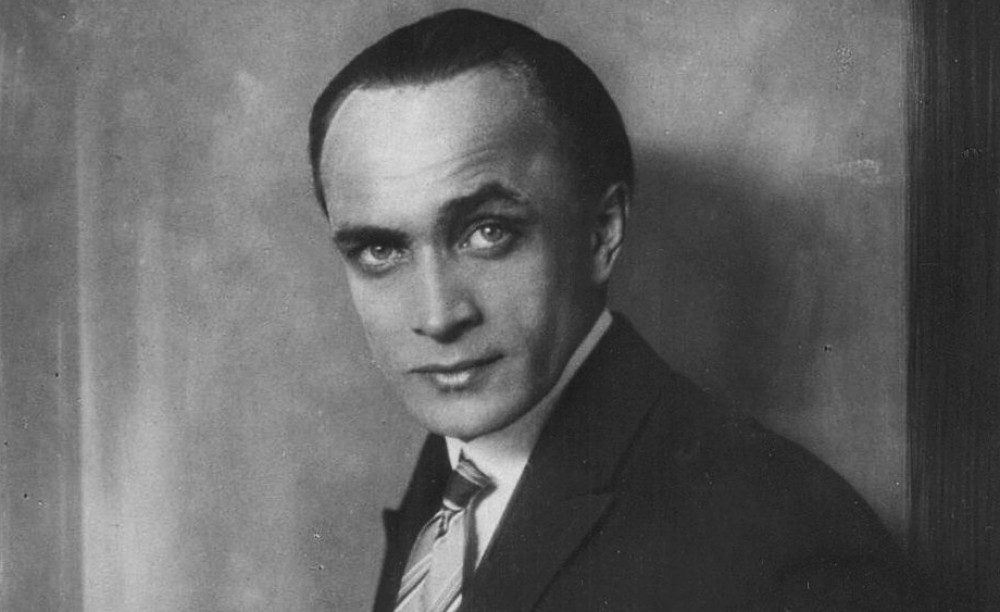

Monica Ilie-Prica: Thank you, Mr. Rathlesberger, for accepting this interview dedicated to Connie, on the occasion of his 83rd death anniversary. First of all, I would like to know what made you become an admirer of Conrad Veidt? What was the first film of his that you saw?
Jim Rathlesberger: One 1985 evening in Greenwich Village, scrolling through the array of stations newly available on New York City cable television, I discovered Dark Journey.
I had never heard of Conrad Veidt, and made no connection with Major Strasser of the Third Reich nor childhood View-Master memories of Jaffar. But intrigued I watched this film again and again. Scouring the listings, I found Veidt in other films including Nazi Agent and All Through the Night.
Sensing there was something special about him in life as well as film, Elizabeth and I searched The New York Public Library’s old-fashioned card files. There we found a number of entries including one referencing Jerry C. Allen’s 1987 Conrad Veidt, From Caligari to Casablanca!
It confirmed everything. If there was not a Conrad Veidt Society already, we had to start one! Our perception of Conrad Veidt was not as a champion of causes, but as a person of character who followed his principles in life and work. We sought to honor not only the Great Actor but a life personifying “Courage, Integrity and Humanity,” which we made the motto on the CVS letterhead. Despite his preference for privacy in London and Hollywood, he had become, in our view, a symbol of resistance from the Arts Community.
Monica Ilie-Prica: You are the founder of the Conrad Veidt Society. Please, tell us more about this foundation and about the most important events that marked its activity.
Jim Rathlesberger: From New York, we reached out to Jerry Allen in Seaside, California. He told us about Pat Battle, a journalist and avid Veidt admirer. Before moving to California and launching CVS in 1989-90, Elizabeth and I met with Pat and Marilyn Searcy at the Plaza Hotel’s Palm Court. There we discussed our plans, with the hotel’s Hungarian string quartet playing background. Pat was working on a biography. Marilyn was keen to be involved.
With me starting a new job in Sacramento, Elizabeth drafted the first CVS Newsletter that we mailed out in March 1990. Sent to the handful of contacts already gathered, it included the aim “to commemorate the 100th anniversary of his birth in 1993.”
From the beginning, CVS linked one small circle of Veidt enthusiasts with another after another. Placing announcements in vintage film publications and handing out flyers during a Caligari screening at the Castro Theatre in San Francisco, the word spread. We met the tremendously helpful Jerry Allen, connected with Gilda Tabarez and others in the Bay Area. Maralyn Kilroy, Shirley Conway, and Vivienne Phillips engaged from the UK. Pat Battle remained a constant adviser. Finding members in seven countries, mainly English-speaking, and realizing Conrad Veidt belonged to the world not to any particular cadre, we highlighted the efforts of all. Lily Veidt’s nephew Ivan Rado accepted the invitation Jerry Allen extended to become Honorary Chairman of The Society.
From the start, there was demand for more than I could do alone. Elizabeth like me had a 24/7 job and projects of her own. We put out a call for a volunteer Networking Coordinator, and our January 22, 1992 Newsletter announced the appointment of Marilyn Searcy. With over a dozen mailings to members, Marilyn shared bibliographies, filmographies, video tape and laserdisc updates, tape conversions, memorabilia, screening alerts, and more—satisfying a hungry need.
CVS encouraged and promoted 1993 Centennial retrospectives and exhibitions by The Museum of Modern Art in New York, The British Film Institute and the Goethe-Institut in London, and La Cinematheque Francaise in Paris. Supported in small part by CVS’s contribution of $450, the Stiftung Deutsche Kinemathek held screenings and exhibitions in conjunction with the Berlin Film Festival and assisted with other programs throughout Germany. It published Conrad Veidt Lebensbilder.
In 1995, Ivan Rado entrusted CVS with most of his remaining Veidt papers and personal items as well as the urn with mixed ashes of Conrad and Lily. The January 1996 CVS Newsletter noted “Many believe the ‘true Berliner’ belongs in his birthplace. Preliminary enquiries have been made to ascertain the interest of German officials. . . . Much of the other material belongs in an archive, properly stored, catalogued, and available to researchers and the public.”
When concerted efforts to take the ashes to Berlin reached a standstill, CVS embraced a suggestion Vivienne Phillips made to me by letter of August 7, 1997 to inter them at Golders Green, London. The Society sent the $760 balance of its $5-annual-dues-based treasury (The Fight for Veidt Fund) for the initial 10-year lease. Vivienne coordinated with Golders Green officials and collected contributions for a lease in perpetuity
Our first 1997 Newsletter noted the Society now had an email address and that “those who have searched on the Web know there is already considerable Veidt information at a click’s command.” Later, we reported “In September 1997 CVS Webmaster Gilda Tabarez startled the Web, debuting the interactive Conrad Veidt Society Home Page! . . . If you are not yet accessing the Internet, please ask someone to show these wonders to you”:
https://www.gildasattic.com/conradveidt.html
It was time to pass on stewardship of CVS to new volunteer hands, and Barbara Peterson answered the call. She launched her magnificent CVS paper newsletter Nocturne in Winter 1997-98. It was soon supplemented, then superseded, by her new website and YahooGroups email.
Elizabeth and I flew the ashes to London and with a dozen and a half others interred Connie and Lily in the Golders Green Columbarium April 3, 1998–55 years to the day since his passing. The ceremony was nicely covered by BBC-Radio and newspapers in both the UK and USA.
Monica Ilie-Prica: Conrad’s only child, Viola, died in 2004 and she had no children. Do you know who inherited everything that belonged to him, after his third wife, Lily, died?
Jim Rathlesberger: Ivan Rado (Lily’s nephew) and Viola were out of touch by the time I came into contact with him in the early 1990s. I never achieved contact with Viola (Jerry Allen corresponded with her), but did with James Henry, the gentleman who became her friend, protector and caregiver. I believe he donated her collection to the same institution we did, The Pacific Film Archive, University of California, Berkeley.
Ivan had previously donated material to institutions in Germany, United Kingdom and France over the years in conjunction with planned retrospectives and commemoratives. What became of items he retained until death, I do not believe we know.
Of the large collection Ivan had entrusted to CVS in 1995, we donated most of the paper (letters, telegrams, photos, posters, two framed displays, legal documents, newspaper clippings, film articles, et cet) to the Pacific Film Archive, University of California, Berkeley in 1996-97 together with our memorabilia from the 1993 Centennial programs and CVS newsletters.
PFA also has from us videos of Conrad Veidt, Magician of the Screen (VHS tape of a German documentary, perhaps from Pat Battle, who sent me many tapes of then hard-to-get Veidt films) and Ivan Rado’s short film Conny. This latter is based on two charming books a fan made with her illustrations of his films from the 1920-30s and gave to Lily upon a chance meeting in New York years later. Ivan kept these two books in his possession.
Also among the papers we gave to PFA are a biographical article Veidt typed in 1937-38 and the December 30,1940 letter from his London solicitor regarding his donations to the children of London during the war.
The Margaret Herrick Library of the Center for Motion Picture Study at the Academy of Motion Picture Arts and Sciences in 1997 accepted from us Connie’s silver cigarette case with “CV” in raised gold, his “CV” engraved gold cigarette lighter, and two scrapbooks that he and Lily had filled with memories.
Film, video, negatives and audio mix of the short film “Conny” that Rado produced using memorabilia inherited from Lily we granted to the University of Southern California Max Kade Institute and UCLA Film & Television Archive. The PFA in Berkeley has a VHS tape of the film. Incidentally, the large collection Jerry Allen intended for the Pacific Film Archive is to my knowledge still retained by his children. Vivienne Phillips’ was donated to the British Film Institute.
Monica Ilie-Prica: Conrad had an impressive filmography and an enormous talent. Fortunately, there are more and more silent films of his that are found in various archives, 100 years later! What “lost” silent films of Conrad would you like to see?
Jim Rathlesberger: All of them, of course! The silent films unveil his talents in their own unique way.
If having to choose one, it would be as for many Der Januskopf (1920), being searched for urgently and thought at the time equal with Caligari. Robert Louis Stevenson’s Jekyll & Hyde story starring Conrad Veidt, directed by F.W. Murnau, shot by Karl Freund, and co-starring Bela Lugosi. It would be an instant classic.
Then the only two films Veidt directed himself—Wahnsinn (1919) and Die Nacht auf Goldenhall (1920). Neither was a hit, but first-release box office receipts are not always the best measure. Both co-starred his first wife Gussy Holl.
Monica Ilie-Prica: Conrad Veidt was one of the greatest actors in the world. He had an international career that started in Germany, then it continued in various European countries, like the UK and France, and he also appeared in major Hollywood productions, like “The Man Who Laughs” and “Casablanca”. What is the Americans’ perception of him? Do people still recognize Conrad Veidt?
Jim Rathlesberger: When we began CVS, before the Internet, and for people like me raised with rabbit-ear antennae on single-station TVs, he was largely forgotten and seemed pretty obscure. Film students, scholars, buffs and other sophisticates knew Conrad Veidt, yet they were not necessarily of a fan-club-joining variety.
We learned that prior to our project there had been a Conrad Veidt Society in Germany circa 1970s. It disappeared with hardly a trace following the passing of its organizer.
Without exaggeration, what all of us have done, through organization, programs and publicity (and I have just summarized some of the more significant work here) resulted in a Conrad Veidt renaissance, getting the attention of media and program managers. Pat Battle and Ivan Rado were unable to get their books published, but John Soister and Sabine Schwientek did. New authors are at work. There is as you mentioned a continuing stream of lost films being found and restored.
To the average USA resident, it might always be “Who?” Fortunately, we can say “Well, you’ve seen Casablanca?” Most people today have, and you can then say “Major Strasser of the Third Reich.”
Monica Ilie-Prica: In your opinion, are the new technologies, AI, and social media useful in promoting Conrad Veidt’s legacy for future generations?
Jim Rathlesberger: Absolutely!
CVS preceded the internet, websites and email. It was the era of photocopied newsletters, postage stamps, and “snail mail.” Websites (Gilda, Barbara et cet) and group emails were the next. Then Social Media like our own Cabinet here:
https://www.facebook.com/groups/37278498968
AI is empowering even people like me to grab instant clues for what years ago would have meant trips to the library, or, later, extensive online searching.
And these are the technologies young people use. They don’t subscribe to mimeographed newsletters. Their technologies will accelerate beyond my imagination.
The Conrad Veidt Society had barely 100 members when I turned it over to Barbara Peterson. Now our society even just in this Cabinet has well over 800.
Monica Ilie-Prica: Does The Conrad Veidt Society still exist?
Jim Rathlesberger: Barbara Peterson’s “official website of The Conrad Veidt Society” is still online though life’s events have prevented her from updating it:
https://thethunderchild.com/ActorSites/ConradVeidt/index.html
Yahoo discontinued the Group email, and there are no more paper newsletters, but we all keep in touch on social media—like right now.
So the Society has evolved into the society, bigger and better connected, with more information and activity on the Internet, in theaters, and home media than ever before.
Monica Ilie-Prica: Conrad Veidt was born 133 years ago, in 1893, by the end of the 19th century. He lived for only 50 years, as he passed away in 1943, in the middle of WWII, a war that marked the history of the 20th century. We now live in a different world, in the 21st century. Conrad Veidt is still with us as long as his memory is alive. How do you envision his image and impact on his fans in the future?
Jim Rathlesberger: He will be remembered as a phenomenal Artist. A Magician of the Screen. Genius actor before the lens. He will be remembered for as long as we have now remembered the plays of Ancient Greece. And his fans will have images—still and moving, very moving. He will be remembered as a Star with principles worthy of emulation, unbowing to prejudice or tyranny, generous and kind to others. A Gentleman without known record of ever expressing anything mean, small or insensitive.


Monica Ilie-Prica: Thank you, Mr. Soister, for accepting this interview dedicated to Connie, on the occasion of his 133rd birthday. First of all, I want to congratulate you on your admirable work. One of your books, Conrad Veidt On Screen: A Comprehensive Illustrated Filmography, is a great accomplishment! I bought the book in 2010 and it helped me a lot in my search for Connie’s films. Every Conrad Veidt fan should have it! I would like to know what made you write this book. Are you a fan of Conrad Veidt?
John T. Soister: I’ve been a fan of Claude Rains and Conrad Veidt since I was a pre-teen. I came to know Claude via the Shock Theater TV series that ran the old ’30s and ’40s Universal horror pictures on TV. I first saw Connie working opposite Claude in Casablanca, and not long thereafter I attended a film program down in Greenwich Village that – over the course of 4 weeks – screened The Golem, The Cabinet of Dr. Caligari, Nosferatu, and Waxworks. I was immediately obsessed with Connie, Paul Wegener, Werner Krauss, and Max Shreck.
Monica Ilie-Prica: The book is so well-researched! How did you find all that information?
John T. Soister: From my friends Henry Nicolella, Olaf Brill, Werner Mohr, Michaela Krause, Pat Wilks Battle, Robert G. Dickson, Richard Bojarski, John Parnum, JoAnna Wioskowski, and Geoffrey Wheeler. In addition, I reached out to the following organizations throughout Western Civilization: Bibliotheque de Film (Corinne Malgouyard), Deutsches Filminstitut (Brigitte Capitain), Cineteca Nazionale (Adriano Apra and Elisabetta Bruscolini), the Museum of Modern Art (Mary Corliss and Charles Silver), the Library of Congress (Madeline Matz), and the British Film Institute (Ayesha Khan and Tessa Forbes). And literally dozens of other folks who shared the same interests as I.
Monica Ilie-Prica: Some of Conrad Veidt’s films that were considered lost appeared in various archives, and in very good condition, considering the age. Do you intend to publish a new book about Conrad Veidt, perhaps a revised edition of his filmography?
John T. Soister: Although I dearly wish they had become available as I was wending my way through my manuscript, I am grateful-isimo that they have turned up, regardless of where and (I suppose) when. It’s time for you to pick up the gauntlet and come out with the latest – and most complete – biography of Connie. I’ve contributed my share of the overall treasure, so – as I just wrote – ’tis your turn, Monica!
Monica Ilie-Prica: What is your opinion about Conrad Veidt’s legacy?
John T. Soister: The legacy of Connie is vast and varied. He has pretty much contributed to all known film genres (perhaps with the exception of broad comedy, a genre the Germans have never made their own), and as apparently the number of his cinematic efforts that are available (at least) to scholars grows with each successive year, overall awareness of his talent and genius will also assuredly grow.
Monica Ilie-Prica: How can we keep Conrad Veidt’s memory alive?
John T. Soister: Televising his most famous films, holding pertinent “cons” and film shows, publishing relevant material.
My special video tribute on the occasion of Conrad Veidt’s 133rd birthday. My original postcard collection from the late 1910’s, 1920’s and 1930’s.

